



Innocent Until Proven Guilty: The Rushed Prosecution of Delaware State Students Must Serve as a Wake-Up Call
Read time: 4:32 | Opinion
On May 19, 2026, four Delaware State University students organized a gathering at the Rehoboth Beach Bandstand. Before the night was over, they were under arrest. Within twenty-four hours, they had been charged with intent to incite a riot — a felony — their mugshots circulating on social media, their names broadcast nationally, and their reputations placed on trial in the unforgiving court of public opinion. Ten days later, the Delaware Department of Justice dropped all charges, finding “no factual basis” to charge any of the four with any criminal offense.
Let that sink in. No factual basis. Not insufficient evidence. Not a weak case. No factual basis whatsoever.
The Southern Delaware Alliance for Racial Justice believes this sequence of events demands both our gratitude and our honest reflection. We are grateful to the Delaware Attorney General’s office for acting with integrity and independence. We are grateful to the Delaware NAACP State Conference of Branches and its president, Fleur McKendell, for acting swiftly and forcefully. And we are grateful that, in this instance, the system ultimately worked. But we cannot celebrate that outcome without being clear-eyed about the injustice that preceded it.
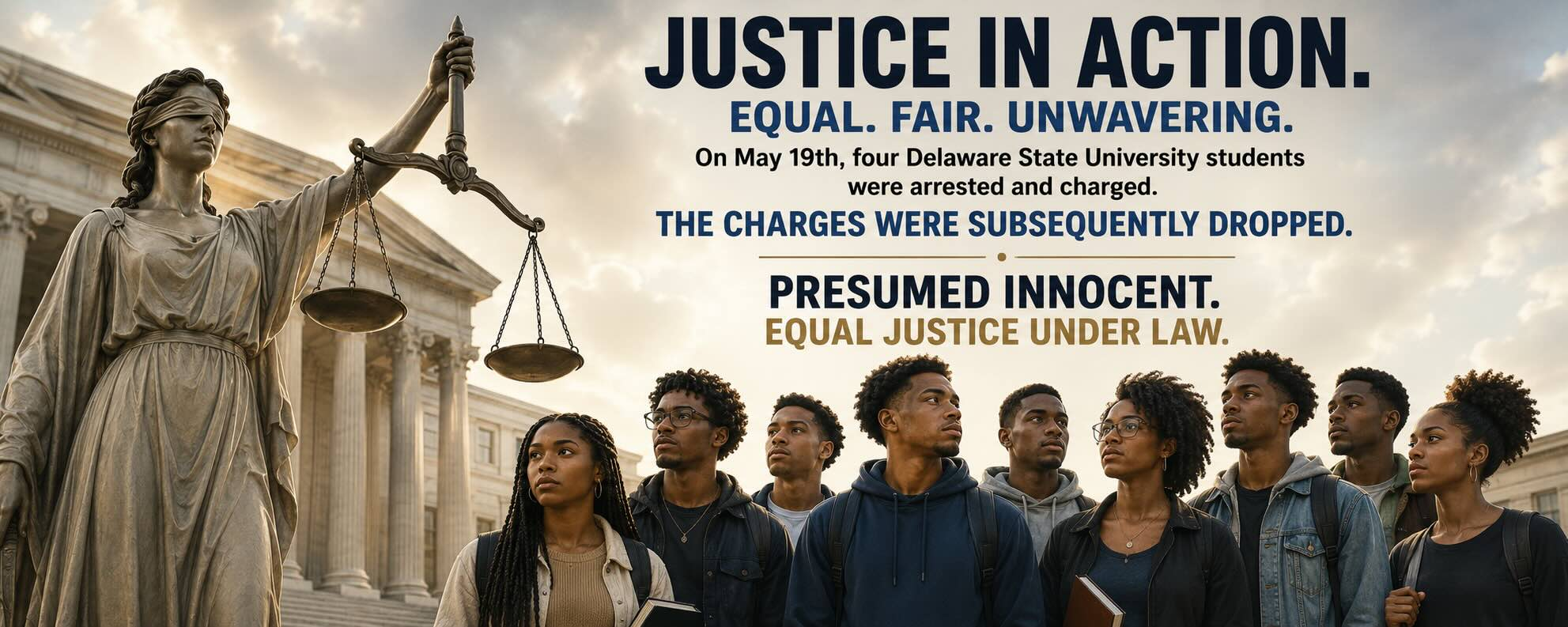
A Rush to Judgment
Police charged these four young men with a felony — a serious crime that can follow someone for life — without consulting prosecutors first. The Delaware News Journal reported that “prosecutors had not been involved in the charging decisions” when those charges were announced to the world. That is not how the system is supposed to work. The felony charge carries consequences that can shatter a life: expulsion from school, loss of financial aid, employment barriers, and the permanent stigma of a criminal record. The Attorney General found no basis for it. These four students — college students with futures in front of them — were subjected to the full humiliating machinery of felony prosecution for something that did not, legally speaking, rise to a crime at all.
Overcharging: A Pattern That Cannot Be Ignored
Overcharging — filing charges more serious than the facts support — is a well-documented problem in American justice. It happens to people of all backgrounds, but study after study confirms it falls disproportionately on African Americans. When NAACP President McKendell asked whether “similar gatherings or crowd-related incidents involving other groups” would have produced the same felony warrants and the same national media firestorm, she was asking the right question. Rehoboth Beach owes the public a clear answer.
One of the students, Angelin Clauvin, a 21-year-old business major at Delaware State, put it plainly: “there was a lot of young Black men in one area, and for some reason it made people nervous.” We cannot dismiss that perspective. History demands that we take it seriously.
The Weight of History
As we approach the 250th anniversary of American independence, we must remember what happens when rushes to judgment go unchecked. There was a time, not so very long ago, when a Black man or woman accused of a crime — any crime, real or imagined — could be imprisoned without trial, or worse, lynched before ever seeing a courtroom. These were not distant aberrations. They happened in Delaware. They happened in Sussex County. They happened in living memory.
This is why “innocent until proven guilty” is not just a legal formality. It is a moral imperative forged in the bitter experience of a nation that failed it, repeatedly and catastrophically, for generations. Every time someone shares a mugshot before conviction, every time social media becomes a venue for verdict before trial, we are chipping away at a foundation built, at enormous cost, to prevent exactly that kind of irreversible harm.
Gratitude Where Gratitude Is Due
The SDARJ expresses deep gratitude to the Delaware NAACP and President Fleur McKendell for standing up immediately and without equivocation — writing letters, demanding meetings, requesting data, and refusing to let this be swept aside. The students and their families owe the NAACP a debt, and so does this community. We equally commend the Delaware Attorney General’s office for its independent review and honest conclusion. Prosecutors are supposed to be gatekeepers against charges that should never have been filed. In this case, they fulfilled that role.
What Still Needs to Happen
The charges have been dropped, but the damage has not been undone. These young men’s faces were circulated nationally. Their names were attached to the word “felony.” Their families endured days of fear and uncertainty. As McKendell rightly said, “the reputational, professional and long-term personal damage resulting from these actions can’t be dismissed as incidental or collateral.” A quiet dismissal is not justice — it is the minimum. The city’s independent review must produce real accountability, not serve as an indefinite shield against it. Black families and visitors will come to Rehoboth Beach this summer — as they always have, and as they are welcome to do. They deserve to know this city sees them as guests, not as threats.
What Makes America Great
We believe deeply in the American justice system — not because it is perfect, but because it contains within it the tools to correct itself when people of good faith and courage demand that it do so. That is what happened here: the attorney general’s office found the truth and acted on it; a civil rights organization stood up and refused to be brushed aside; and four young men who should never have been put through this ordeal can return to their studies and their futures.
To those who shared the mugshots and rendered verdicts on social media before a single fact was fully examined: we ask you to reflect on that. Always seek both sides of the story. The presumption of innocence only means something when we extend it to people we are instinctively inclined to judge.
Delaware’s justice system did the right thing, and that matters. It is what makes America great — not that we never make mistakes, but that we have the institutions, and sometimes the courage, to correct them. Innocent until proven guilty is not just a legal phrase. It is a promise. For these four young men, that promise was kept.