



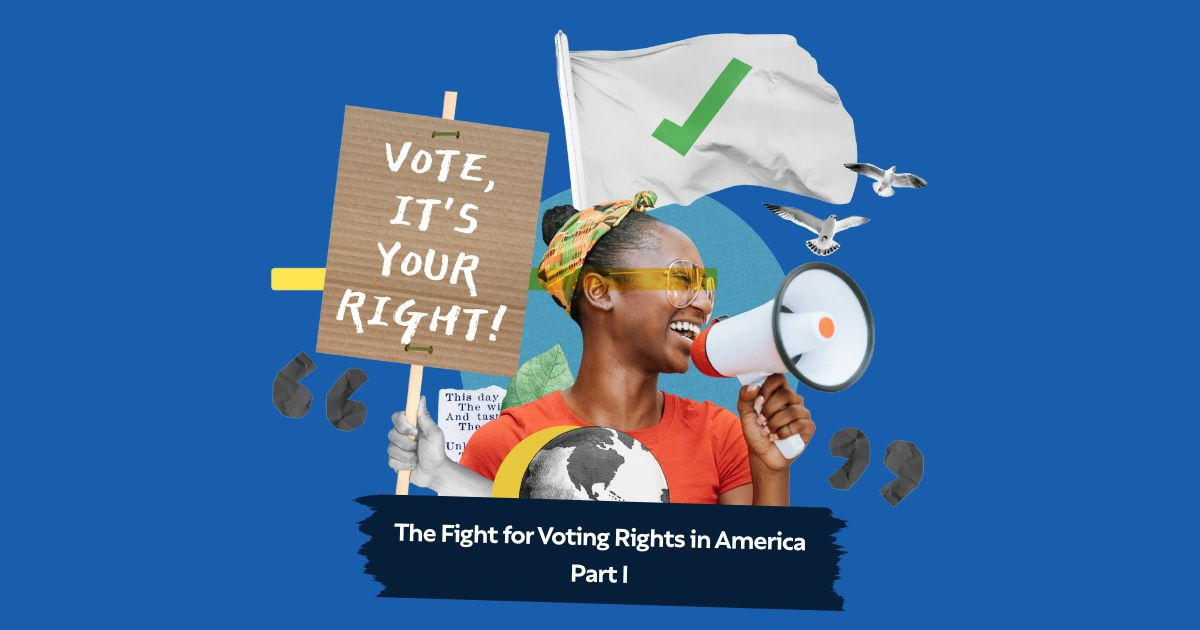
The Fight for Voting Rights in America Part 1
By: Jessica Clark
Part 1 | Part 2
This article was originally published in Black Voices Vol 16. The Democracy Issue. A newsmagazine distributed as an insert for Cape Gazette subscribers. You can read the digital version here.
After retirement, as an adult education English as a Second Language teacher, for one module I began discussing U.S. history, the Declaration of Independence, and the Constitution preparing students to become citizens. My mostly Hispanic and Haitian students were expected to know the answers to 100 questions although the actual citizenship test required answers to only twenty-five random questions. In the ten years I taught, not one of my students failed the citizenship test. I wonder, readers, how many of you could pass the random test?
As early as 1789, the Constitution granted states the power to set voting requirements mostly limited to property-owning and tax-paying White males. A few states allowed free Black men to vote and New Jersey included unmarried and widowed women who owned property to vote. It wasn’t until 1870, when the 15th Amendment was ratified, that Black and White men had the right to vote. But Black citizens were still disenfranchised due to Jim Crow tactics such as literacy tests, poll taxes, intimidation, and violence. It wasn’t until the passage of the 1965 Voting Rights Act that Black men were granted the full right to vote. In 1920, three quarters of the states voted to give women – selectively white women – the right to vote and the 19th Amendment was added to the Constitution. Even today, southern voters, especially in communities of color, still deal with modern-day voter suppression.
The right to vote for Black and White women began in the 1800s when women realized they needed voting rights to reform child labor laws and promote public health. The women’s suffrage movement began in 1869 with disagreements about the 15th Amendment granting voting rights to Black men but not women. To extend the vote to women, suffrage depended upon male supporters, who were state legislators and members of Congress. The movement, for the most part, excluded Black women’s efforts. Getting the constitutional amendment required three-quarters of the 48 states in the union.
The women’s suffrage movement historically excluded Black women’s efforts, with a few exceptions. In 1896, the National Association of Colored Women called for reforms to address the economic, educational and social welfare of Black women and children, such as job training programs, fair wages, and child care. Alternatively, thousands of White women opposed suffrage stating it would undermine women’s influence in the home and family. They framed their roles, as wives and mothers, as political virtues to advance a more moral government.
In 1916, Jeannette Rankin, a White woman and committed suffragette from Montana, was greeted by lawmakers with a standing ovation when she became the first woman elected to Congress. For several months, in 1917, the National Women’s Party protested in silence six days a week, outside the White House to pressure President Woodrow Wilson to support women’s suffrage. On November 10, 1917, thirty-three suffragists were arrested and jailed. They were fed maggot-infested food, beaten and tortured. The suffragists protested with a hunger strike and were brutally force fed. They were released after the Washington, D.C. Court of Appeals ruled their arrests unconstitutional.
Not to be intimidated, Black women and men continued the fight for voting rights. In 1920, Mary McLeod Bethune led Florida voter registration drives while risking racist attacks. Fannie Lou Hamer, the youngest of 20 children born into a sharecropping family and the granddaughter of enslaved people, organized Black voter registration efforts in the South in the early 1960s. In 1963, she and other activists were arrested at a café and held down during an almost fatal beating in a Mississippi jail when she started to scream. They endured four days of abuse. The incident left her with profound physical and psychological effects including a blood clot over her left eye, permanent kidney damage, and a worsened limp. At the 1964 Democratic National Convention, she boldly denounced state-sanctioned violence and described white supremists’ racist violence attempts to block Black people from voting. She stated, with tears in her eyes, “In this America, the land of the free and the home of the brave, where we have to sleep with our telephones off the hooks because our lives be threatened daily, because we want to live as decent human beings, in America?”
Women had full voting rights in 15 states and the Alaska territory, but limited suffrage, including voting in presidential elections, in another 12 states before 1920. Women’s influence helped build momentum for the 19th Amendment. Yet, still, women of color were often kept from the polls through a variety of tactics; they faced racial and ethnic discrimination and were often violently discouraged from voting. Congress approved the 19th Amendment in 1919 with bipartisan support and according to the 1920 Census, some 500,000 Black women voted in states where their male counterparts were enfranchised. The 19th Amendment was ratified on August 18, 1920 granting women the right to vote. The amendment stated, “The right of citizens of the United States to vote shall not be denied or abridged by the United States or by any State on account of sex.” More than 10 million women voted in 1920. Women voter turnout rates have gradually increased and exceeded male turnout rates since 1980.
On March 7, 1965, Martin Luther King, Jr. led 500 activists 54 miles walking around the clock for three days from Selma to the capital in Montgomery, Alabama, to demand voting rights for Black citizens and emphasize the need for a national Voting Rights Act. The world watched while the peaceful demonstrators were brutally attacked by law enforcement. In the ensuing chaos, a state trooper fatally shot Jimmie Lee Jackson, a young Black demonstrator. State troopers wielding whips, nightsticks and tear gas rushed the group at the Edmund Pettis Bridge and beat them back to Selma. Hundreds of ministers, priests, rabbis and social activists soon headed to Selma to join the voting rights march.
On March 9, King led more than 2,000 marchers, Black and White, across the bridge into a blocked highway by state troopers. Reverend King paused the marchers and led them in prayer and the troopers stepped aside. But in spite of the group turning around, a group of segregationists attacked another protester, the young White minister, James Reb, beating him to death. State officials tried to prevent the march from going forward but a U.S. District Judge permitted the march. On March 21, 2,000 people marched, protected by U.S. Army troops and Alabama National Guard that then-President Lyndon B. Johnson ordered. After walking some 12 hours a day and sleeping in fields along the way, they reached Montgomery on March 25. Nearly 50,000 supporters – Black and White – met the marchers in front of the state capital to hear King and other speakers address the crowd. “No tide of racism can stop us,” King proclaimed, as the world watched the historic moment on television.
President Lyndon B. Johnson addressed a joint session of Congress, calling for federal voting rights legislation to protect Black Americans from barriers preventing them from voting. In August, Congress passed the Voting Rights Act of 1965 outlawing discriminatory voting barriers such as literacy tests as a requirement for voting, mandated federal oversight of voter registration in areas where tests had previously been used and gave the U.S. attorney general the duty of challenging the use of poll taxes for state and local elections.
The right of U.S. citizens to vote:
15th Amendment
“…shall not be denied or abridged. on account of race, color, or previous condition of servitude.”
19th Amendment
“…shall not be denied or abridged by the United States or by any State on account of sex.”
24th Amendment
“…shall not be denied or abridged…by reason of failure to pay any poll tax or other tax.”
26th Amendment
“…who are eighteen years of age or older, to vote shall not be denied or abridged by the United States or by any State on account of age.”
Part 2 will discuss some more recent fights for voting rights.