Planting Opportunity: Closing the Achievement Gap by Confronting the Opportunity Gap
By Travis Bouldin
This article was originally published in Volume 17 of Black Voices.
When we talk about the education of Black students in America, the conversation often begins with the long shadow of systemic injustice: underfunded schools, segregated neighborhoods, and policies designed to exclude rather than uplift. These are real forces, deeply rooted in history, and they continue to shape the opportunities available to our young people today. But if the story ends there, we are left powerless, waiting for others to correct what has been broken. I believe our story deserves a different ending, one rooted in accountability, resilience, and the work we choose to do within our own communities.
As an educator and farmer, I have the privilege of teaching horticultural science to Black students in Washington, D.C. My classroom is not just desks and textbooks, but greenhouses, goats, chickens, and raised beds. Students are given the chance to see, touch, and grow. This type of education is rare in urban settings, yet it exposes an unsettling truth: many of our young people have never been given access to the most basic tools of labor, creativity, and care. I have had students who do not know how to hold a rake or push a shovel into the ground. Some have never picked up a watering can or pruned a plant. These moments remind us that while twenty first century skills such as digital literacy and critical thinking are vital, we cannot overlook skills of trade that often appear outdated or forgotten. Food production will always be necessary, and teaching students how to produce, prepare, and sustain life through agriculture ensures that they gain both timeless and modern abilities.
This deficit is not a matter of intelligence.
Our students are bright, capable, and imaginative. It is a deficit of opportunity. What many call an achievement gap is really an opportunity gap. In a society where digital devices are placed in children’s hands earlier than ever, it is possible to be fluent in apps and shortcuts but unfamiliar with the tactile skills that build independence and resilience. Career and Technical Education provides experiences that go far beyond working with soil or animals. These projects teach responsibility, patience, problem solving, and collaboration. They cultivate the soft skills that are just as critical in the workplace as they are in community settings or even in communicating effectively with family. When young people are denied these opportunities, they are robbed of the chance to build confidence in their ability to shape and sustain the world around them.
Yet here lies the turning point: acknowledging what is missing cannot be an invitation to despair. Instead, it should be a challenge to all of us, educators, parents, churches, and communities, to fill in the gaps. We cannot wait for policymakers or distant reformers to swoop in with perfect solutions. We must plant opportunity with our own hands.
In my classroom, that planting is literal.
Black students are entrusted with living things: animals that need feeding, plants that need tending, soil that needs care. These experiences awaken something fundamental: the understanding that they have the power to create, to nurture, and to sustain. Watching a student who once shrugged off responsibility grow into someone who eagerly arrives early to check on goats or carefully waters crops is a reminder of what is possible when we trust young people with real tasks.
Travel plays a role as well. Through Minorities in Agriculture, Natural Resources, and Related Sciences, my students have seen a world larger than their blocks or schools. They have walked into rooms where Black youth are leaders in agriculture, environmental work, natural resources, and business. Exposure broadens vision, and once a vision expands, it is hard to shrink it back.
Of course, challenges remain.
Some students resist. Some are skeptical. Some carry trauma that cannot be solved by a shovel or a greenhouse. But accountability matters. Our students must be reminded that while history has dealt them an uneven hand, they still bear the responsibility to play that hand with integrity, determination, and courage. We cannot allow oppression to become an excuse for mediocrity. Excellence is not optional. It is survival, and it is also the measure of honoring those who fought for the very right to learn.
This dual message, that the world must change but that we must also change ourselves, is not easy to deliver. Yet I believe it is the only honest way forward. Yes, we demand equity in funding, fair treatment in policy, and inclusion in opportunity. But within our homes, our schools, and our communities, we must also cultivate discipline, curiosity, and resilience. We must encourage our students to put down their phones long enough to pick up a book, a tool, or a seed. We must remind them that their future does not only depend on what society gives, but on what they are willing to build.
Agriculture has taught me a truth I carry into every classroom: growth is both a gift and a responsibility. Seeds cannot plant themselves. Soil does not till itself. Harvest does not appear without sweat. In the same way, our students cannot thrive without us, their elders, mentors, and teachers, providing not just access but expectation.
The inequities Black students face are undeniable. But so too is the potential that lives within them. Our role is not only to protest what is broken, but to model what is possible. By placing tools in their hands, exposing them to new worlds, and holding them accountable to their own greatness, we give them more than education. We give them agency. And agency is the first step toward liberation.
If there is one lesson I hope to leave with my students, it is this: you are not defined by what the world withholds, but by what you choose to cultivate.
About the author

Bouldin is a horticulture science instructor and community farmer based in Washington, D.C. He leads programs that connect Black students to agriculture, animal care, and career pathways through hands-on education and national leadership experiences. His work focuses on closing opportunity gaps, strengthening communities, and preparing youth for the workforce.
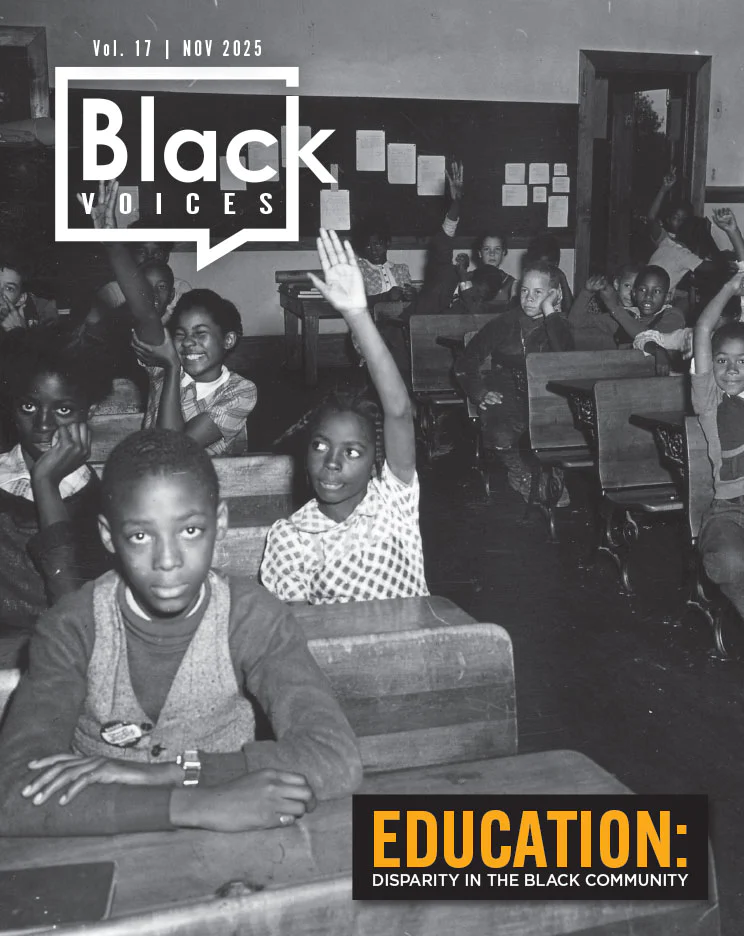
Black Voices Newsmagazine
Read the current issue of Black Voices and browse through previous volumes in the archives. A hard copy of Black Voices is being distributed as an insert for Cape Gazette subscribers.